Friday, May 19, 2017

Why make pelelts from oak wood?


About Oak Wood Pellets
This kind of pellet appeared in our offer in 2011 and from the very beginning has been gaining larger and larger group of customers. Deciduous sawdust, noble oak tree - all this had an impact on high demand. Hardwood – oak does not dirty chimney openings, as it happens in case of pine or spruce, which was also noticed by the customers. This pellet is produced from its own sawdust, so that the quality and its composition is fully under control. This is very important in the production of a high quality pellet. The granulate itself is produced on the specially prepared, reamed dies of Italian manufacturer of devices destined for pellets production. The reaming is necessary due to the fact that oak sawdust has very little resin and bonding it to the form of pellets was quite a big challenge. A very attractive price is an additional motivation for our customers to purchase this kind of pellet. Pellets made of pure oak sawdust, contains no binders, adhesives, chemicals.

Oak wood pellets for BBQ
When BBQ pellet companies refer to a 'base' in their pellets, they are taking about the stable hardwood substance of their pellet. Most companies either use oak or alder as their base, we like to use alder. All of our flavors of pellets have a 75% alder base, with the other 25% being the main flavored hardwood. For example, our hickory pellets are 75% alder 25% hickory, our mesquite pellets are 75% alder 25% mesquite, and so on.

These Oak wood bbq pellets are 100% wood with no additives, mixes, cheap fillers, just good old fashion bbq wood the way it should be!

The pellets are of light brown colour because of used oak sawdust. Their darker colour does not mean lower quality as is often suggested. Oak is valuable natural fuel, which is why our pellets have high calorific value 18,51 MJ/kg, burning time 30% higher than coniferous wood and low ash content (0,49%). Because of the longer burning time, it is necessary to adjust batching to boilers and reduce it by about a third when switching to hardwood pellets.

What is the difference between oak pellets and pellets from coniferous tree species?
The first distinguishing feature is the colour. Darker colour of oak pellets is given by natural brown colour of wood. There is a common misconception in a society according to which the pellets of dark colour are generally of poor quality because they must contain the bark. However, it is not so. Pellet containing bark can be identified by irregular dark spots. If the pellet is darker as a whole but without significant dark spots, it is not a pellet containing bark. Another difference compared to pellets from coniferous wood is burning time, which is about 30% longer. It is necessary to adjust batching to boilers and reduce it by about a third.

How can we recognize the quality pellets?
At first glance you can recognize the quality of pellets mainly according to their colour and shape. The pellet should be uniform in colour, without spots and its surface should be shiny and compact. Pellet quality also depends on the used technology which reflects in hardness of pellets. The harder the pellets, the better their production process.
Important parameters of the quality are heating power, water content and ash content. Pellets that meet ÖNORM M 135, DIN plus or EN PLUS A1 have set values parameters ​​that guarantee the highest quality of pellets.

Monday, January 23, 2017

Complete Wood Pellet Plant Process


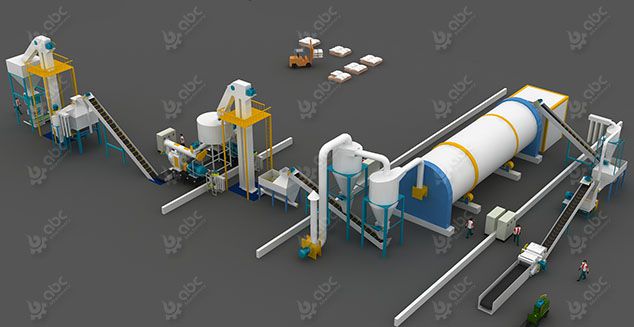
Usually a whole biomass pelletizing plant includes the following sections: raw materials crushing, drying, pelletizing, cooling and packing. The pelleting process varies from one raw material to another. Feel free to contact us for detailed pelletizing plan for your raw material. The following shows the complete biofuel pellet plant from raw wood (logs).

Debarking
If you use wood logs, timber or lumber as material for a wood pellet Plant, the first step is to debark logs to facilitate following steps of chipping and pulverization, therefore a wood barking machine is demanded.

Chipping
The step is to reduce size of the material from logs to wood chips with the universal size of about 2cm*2cm for pulverization.

Hammer Mill
Generally, hammer mill will be applied to crush chipps into smaller size of powder. However, a, integrated crusher can be used as well to decrease size of material for pelletization. Besides, two-time pulverizing may be considered as well to achieve a better pelletizing performance and ensure pellet mill will work stably.

Screening
A sifter is bound to use if the material you possess are beyond purity. The step is to cleanse and purify material with iron scraps, oversized impurities and alleviate damages as well as wear and tear to successive machines. Apart from the special sifting equipment, We will offer magnet tubes installed on conveyers and pre-pelletizing surge bin to multi-deironing metal foreigner matters.

Drying
The moisture content of material may remain higher than the required for pelletization. Therefore drying system is needed to reduce moisture content to about 12%-15% for pelletization.

Pelletizing
Flat die pellet machine is the best equipment for small scale pellet production (capacity 200~1000kg/hour), while for large-scale projects, ring die pellet machine is recommended.

Pellet mill is the most pivotal machine within a pellet plant. After being pelletized, material will be formed into granule shape or column/cylinder shape. For a larger scale plant, from time to time more than one wood pellet mill is needed, for example 4 or 6 tons pellets per hour and ABC Machinery is also excelling in providing large scale wood pellet plants combined with pellet mill assembly.

Dedusting System
Alongside pellet Plants, dedusting system is entitled to putting into practice with pelletizing system for reducing fly ash emissions. ABC Machinery adheres to the concept of environmental protection and purifying working environment. The cleaning system is composed of pulse dust collector, cyclone, pipeline and air lock.
ABC Machinery can provide clients with either manual dust collector and pneumatic pulse dust collector based upon different needs. Pulse dust collector is upgraded based upon Manual dust colletor but equipped with pneumatic system and metal cover so that manual force can be replaced by automatic dedusting system. Besides, the bags inside can be renewed with low costs and less maintenance.

Cooling
Newly produced biomass pellets are scolding due to the high temperature and high pressure during pelletizing. And a cooler will then be demanded to ensure the ensuing packaging and a longer storage time of pellets.

Sifting
Some powdery material may also flow from pellet mill with qualified pellets, in this regard, it is proved that a sieve will separate the small amount of disqualified mealy material from good pellets and also to qualify pellet packages.

Packaging & Slealing
Packing scale can be inquired with ABC Mahcinery too. Pellets can be weighed and packed in bags to facilitate pellet storage, transportation and marketing. The packing scale models are varied according to clients' demands. We can offer both small bag packing scale and bulk bag packing scale. And Packing machine offered by ABC Machinery is also integrated with sealing machine as a whole.
Wood pellet plants manufactured by ABC Machinery cover a wide range of pruduction yield from 0.5t/h to 12t/h, but for a smaller pellet plant with production output of less than 0.5t/h, it can be offered as well such as a biomass pellet project of 300kg/h or 200kg/h. Link to moveable pellet plant.

Electric Control System
Within a pellet plant, PLC electrical control system is mainly applied and ABC Machinery  can offer PLC system with lavishly professional experience. And the PLC cabinet can be printed on the surface with operator-oriented mimic diagram of pellet plant so that operators can get to know the entire system and master control procedures.

As we know, Regulations and provisions on electricity are different from one country to another. ABC Machinery has accumulated seasoned skills and abundant experience in connecting a variety of eletrical control system with pellet plant. Therefore, ABC Machinery can offer both standardized electrical system based upon China's use and the ones according to your demands to meet local standards for clients.

Monday, October 10, 2016

FAQs of Flour Mill Plant

Q: How much noise of a 160 TPD wheat flour plant? How to reduce the noise to 70-75 db?
A: Since there are many machines in flour plant workshop and the customer choose the steel frame workshop which the sound insulation is poor.
The noise outside the workshop cannot reduce too much. Inside the workshop, the biggest noise machines are high pressure fan, the roots blower, air compressor. The air compressor and roots blower are placed in separate workshop. If the noise too big, the customer can paint special material on the wall to absorb noise. The high pressure fan is placed in workshop, and the outlet noise is about 110db, if the customer want to reduce the noise, he can add the silencer on outlet, that can reduce 15 db noise, and after connect the tube with pulse dust-remover, the noise can be 10 db lower, then the final noise of high pressure fan can reach 75db.


Q:Is it possible to lower the 300 tons maize moisture from 17%-23% to 13%-14% in one hour?
A:The dryer tower is not enough ,the largest capacity for the dry tower we have is 1000 tons per day ,and the 300 tons per hour need 7 dry tower ,the cost is quite high.
Click to learn more about 300TPD Flour Mill Plant


Q: Is one 10 tons per day flour processing plant can process both maize and wheat?
A: The maize and wheat processability is quite difference,and the maize size is larger, during the processing, it did not need add any water. But the wheat need to be tempered 24 hours before milling, and need to remove the bran. The producing technology is different.

Q: What is the cover area for one 200 tons per day flour mill plant with 2 set of 500 tons silo ?
A: About 60*15 meter, and that area not include the final product warehouse, if add it, the size need be 500 square meter larger.


Q: For the 100 tons per day flour mill plant, if the workshop height is 8-10 meter, is it enough?
A: The height is not enough. If the height is 10 meter, you can dig one meter below the floor ,that will be enough, and if only 8 meter, it will not enough.


Q: Is the 1 t/h flour line can process the barley ,wheat and maize at the same time?
A: It is very hard .But if you can confirm which material is the main material, you can peeling first and then milling ,then the material will be similar and easy to grind.


Q: What about the main differences between our equipments and Pingle’s?
A: Not much different, process design similar equipment selection is similar, but the price we will be relatively low, we will be more flexible device configuration, you can use all aspects of domestic stand-alone device to do good, more scientific.


Q: Can you produce pasta line that can make 25 thousand tons per three months?
A: Pasta production line is generally relatively small, expensive large-scale production line, 400kg/h pasta line is to be more than seven hundred thousand dollars, three months, then 25,000 tons, equivalent to 12 tons per hour, our largest line of 1.5t / h, if you want to 12t / h, the need to invest in more than $ 15 million.


Q: Is there two different designs for the 30 tons per day flour line, one is one floor, and another is 2 floors?
A: The 30 tons per day flour line can be designed to vertical version and horizontal version. The 2 floor (Vertical design) is the flour mill in the first floor and the double sifter in second floor, which use less tube. The frame is steel frame with beautiful outlook. The one floor design is the roller mill and the double sifter in one floor without steel frame, which can save the height of the workshop.

Q: What is the difference between 10 tons per day wheat flour line and 20 tons per day wheat flour line?
A: The 20 tons per day wheat flour line include 5 roller mills, and the material is not need to be recycled. It is also equipped with one double sifter which can make sure the flour more uniformity .4 roller mill grind the bran material and the other one deal with the wheat center material.
For the 10 tons per day wheat flour line ,it only include 2 roller mill ,one is for bran material and another for wheat center material ,since it need 4-5 time to mill the germ of the bran material ,so the material need to be recycled into the mill for may times.


Q: What is the difference between cassava flour and wheat flour?
A: The cassava flour is grinded by dry cassava. The whole cassava is grinded into flour without peeling .The cassava flour can add into the wheat flour to making food, and it is not use alone. The wheat flour is grinded by roller mill, will keep the bran and separate the bran and germ .The wheat flour can be use to make bread, the protein in the flour is the frame of the bread.(Related article: https://bestmachineray.wordpress.com/2016/10/27/30/


Q: Is there one line can process the wheat, maize, sorghum and rice at the same time?
A: Since the material processability are different, is use one same plant, the roller is hard to choose, and during the producing, the material flow is unbalance and hard to clean, since the different material is easy to mix up.


Q: What is the cover area for one 200 tons per day flour mill plant with 2 set of 500 tons silo ?
A: About 60*15 meter ,and that area not include the final product warehouse ,if add it ,the size need be 500 square meter larger.


Q: What is the difference between the Chinese flour mill technology and European technology?
A: The technology is same, but the flour mill plant is different, such as the capacity, for the larger plant, the flour mill plant is similar, but for the plant with small capacity, the working accuracy is not as good as European standard.

Tuesday, June 28, 2016

Palm Oil Industry

The palm oil problem is not about you. It's not about headlines, image or policy statements. It's not about saving the orang-utan by boycotting chocolate with palm oil in it. It's about tackling the problems and playing a part in making ethical, sustainable production the norm.

http://www.palmoilmillplant.com

It's easy to grab plaudits by boycotting palm oil or buying it from a country not associated with the problems. But don't forget that if you shun Malaysia and Indonesia, you turn your back on the orang-utan, the rain forests and the people whose lives depend on palm oil. Malaysia and Indonesia rely on the palm oil industry to provide a living for more than a million people. And the plantations are not all run by profit-driven corporations - between 40 and 45% are smallholdings producing oil that is never exported. (Build a pollution free palm oil production plant>>)

Palm oil production takes place mostly in Indonesia and Malaysia. It's an oil that is reddish in color and used in a lot of southeast Asian and tropical African cooking. Because of its low price and availability, it's starting to be shipped all over the world, which is increasing the production. (Canola oil production line>>)

The oil comes from the fruit of the oil palm and harvesting it can be problematic due to human rights violations and environmental damage. Producing this oil causes severe deforestation, habitat destruction for endangered and other species, and is a contributor to increasing greenhouse gas emissions.

There has been a history of oil harvesters being treated poorly and given inadequate wages as well, and surrounding communities suffer from the pollution and destruction that growing and harvesting these trees can cause. That's why it's so important that this oil be produced sustainably.

The Roundtable on Sustainable Palm Oil, a group founded specifically for the sake of more sustainable oil production, has put together a list of rules and regulations to help improve the situation. They're a coalition of local concerned communities, non government organizations, human rights groups, and others who want to
improve the situation.

This group is looking for more transparency in the work done harvesting oil, and creating systems of production that have long term economic and environmental viability. Growers and millers must be fair and practice only sustainable methods of production, following all laws and regulations that have been set down
for a better system. They must also be environmentally responsible and practice conservation around their plants.

Sustainable palm oil production must also take into consideration the rights and needs of workers and other human beings impacted by the presence of production plants. New trees must continually be planted so as to reduce the effects of deforestation and to provide a sustainable business. And most importantly, everyone
who is involved with the oil production must always been on the lookout for ways to improve harvesting and methods of producing the oil.

Solvent Extraction Plant:This method is utilized in extractiom of palm oil whereby a hydrocarbon-containing substance is usually used as a solvent.

Screw Pressing Plant:.This method is also used to get palm oil from their attachment areas.lndustries prefer this
method of extraction since since it is cheap and ecomical.

Thursday, September 24, 2015

Abaca Fiber Application

Abaca is a leaf fiber extracted from around the trunk region of the abaca plant also known as the manila hemp and is closely related to the banana plant, commonly found in the humid tropics. The fiber is made of long slimmed cells that form part of the supporting structure of the leaf. It is mechanically strong, resistant to damage by saltwater and also has a high buoyancy. It has a long fiber length that reaches up to 3 meters with the best quality of the fiber being lustrous, fine, light beige in color and strong. During harvesting, the stalks are cut into strips that are then scrapped as to get rid of the pulp following the washing and drying of the fibers. Philippines is the world's leading producer of abaca followed by it's closest rival, Ecuador. In both countries, the plant is grown on large estates with production mainly mechanized. The plant is also cultivated in other Southeast Asian countries.

6 TPH Biomass Wood Pellet Line

Abaca fibers are used in the production of a variety of handicraft products: decorative accessories, fashion accessories, textile, garment, packaging materials among others. The fibers are also broadly used in the making of pulp which are then used as raw material in manufacturing bank and currency notes, coffee filters, tea bags, cable insulation papers, adhesive tape papers, charts and maps, computer chips insulation as well as lens and carbonizing tissue. They are also of huge importance in the industrial and medical fields: including being used as composite materials in place of glass fibers in the manufacturing of planes, vehicles and yatches. Building materials such as plumbing fixtures, fiber-boards, reinforced concrete and electricity poles. They are also used to produce telephones, paints, sporing goods and cleaners.

How to improve the output of wood pellet production?

There are mainly two types of pellets that are manufactured with the use of abaca fiber. First, there is there is the multipurpose pellets. These pellets are manufactured and used as forage and feed supplements for livestock. In the manufacturing of these pellets, abaca proportions of between 0.1% to 100% by weight are combined with 99.9% to 0% by weight of cellulostic material are subjected o a series of spheronization and extrusion processes to partition the ratios of the materials according to the desired outcome. Pellets are then manufactured through a series of powder and liquid layering and pelletization through wet and melt granulation processes. Secondly, the fiber is used to produce rationally moulded natural fiber reinforced polythene pellets. (wood pelletizer for sale)These pellets contain internal hollow parts with low internal stresses. This is due to economic cost regarding manufacturing and the scarce availability of materials. In the manufacturing process, the purpose is to obtain hollow parts, high quality surfaces and a perfect distribution of thickness. During the rotational moulding process, abaca is combined with polythene and a few other additives resulting to aesthetics with low formation of clusters and fiber bundles. Upon grinder, the fiber is well distributed in all parts showing smooth surfaces on all parts. Abaca being a virgin natural fiber in this case, improves the mechanical properties of the pellets mostly regarding tensile strength and flexibility. Improvements that are higher than those obtained from the use of glass fibers.

Monday, August 24, 2015

Pellet Machine Application Introduction

Sawdust Pellet Machine Operation Points


ABC Machinery is engaged in sawdust pellet mill plant, straw pellet machine manufacturing.  Our machines have won good evaluation in the market around the world.

Read More:bestpelletmill.wordpress.com

Sawdust Pellet Machine Operation Points

pelletizing plant

Biomass Pelletizing Plant For sawdust pellets machine, pelletizing system is an important section in the whole process, the pellet machine is the key equipment of pelletizing system, its operation is normal, operation is properly, will directly affect the quality of the final product. Combining with the experience of site operation in the past and the theory of knowledge, I want to talk about how to operation the pellets machine correctly.
Read More: http://abcpelletmill.myfreesites.net

Thursday, August 13, 2015

The Common Faults of Straw Pellet Machine

The popularity of straw pellet machine is increasing. A lot of places are available to the straw pellet machine. According to the pellet production experience for many years, we summed up the straw pellet machine common failure problems and hope to be of help.


The first kind of the common problems is that the diameter of the pellets produced by straw pellet machine is too big, not in conformity with the expectation of their particle size. The problem might be caused by two reasons. One reason is that the mesh of pelletizing machine serious wear and tear after working for a long time, making the mesh aperture bigger. So the finished pellets will certainly be bigger. In this cases, you can replace the mesh to fix the problem. Another reason is the clearance between the press roller and the pellet die is too big. In this cases, you can fix it by tighting the fastening screws, to reduce the gap between the two, so as to reduce the diameter of the biomass pellets.

The second common problem is bearing overheating of the straw pellet machine. Sometimes even feels burn the hand. The factors of bearing temperature may be various. It is possible because that the bearing oil shortage, causing friction force too large, producing a lot of calories. The other reason is that the machine is overload for a long time. You must first stop the machine for a period of time, otherwise it may cause damage to the machine and greater economic losses.

If you are looking for straw pellet machine manufacturer on line. www.gcmec.com might be your best choice. You can find both small pellet press and large ring die pellet mahcine on their website. If you are planning to build a production line, go to www.pelletmillsolution.com. They are specialized in building wood pellet lines. You can view the projects on their website and then decide if buy from them. Hope this article really helps.